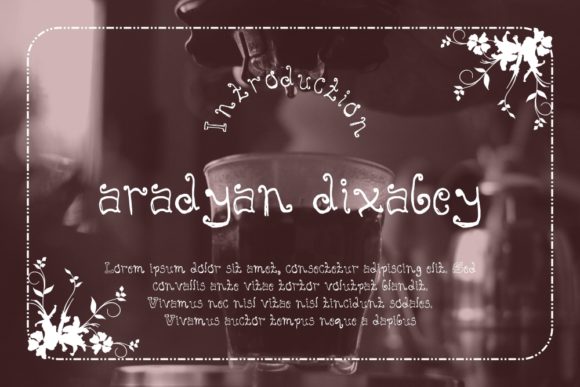
Aradyan Dixabey: A Playful Display Font for Kids’ Crafts & School Projects
If you’ve ever spent an hour tweaking letter spacing on a birthday banner—only to realize the font looks too stiff for a five-year-old’s classroom party—you’ll instantly feel the magic of Aradyan Dixabey. This isn’t just another cheerful display font. It’s a warm, hand-drawn-inspired typeface with gentle curves, uneven baselines, and that unmistakable childlike charm—without sacrificing clarity or cut-ready precision. As someone who designs printable planners, Cricut-cut stickers, boutique gift tags, and seasonal SVG bundles for Etsy, I reach for Aradyan Dixabey when I need joyful energy that still prints cleanly at 0.25 inches or cuts flawlessly on 65 lb cardstock.
What makes Aradyan Dixabey special is how it balances personality with practicality. The letters have soft, rounded terminals and friendly proportions—think “bouncy” rather than “busy.” There are no sharp angles or aggressive serifs, but also no distracting flourishes that gum up small labels or blur on matte-finish mugs. That means it shines where many playful fonts falter: on tiny jar labels for homemade playdough kits, mini chalkboard-style signs for preschool cubbies, or even stitched embroidery patterns (when used as vector outlines). Its open counters and generous x-height ensure readability—even at 14 pt on a printed flashcard or 18 pt on a laminated classroom schedule.
I use Aradyan Dixabey across three core product categories: physical goods, digital printables, and SVG-based craft files. For physical products, it’s my go-to for candle labels (especially for “Storytime Soy” or “Rainbow Learning” scents), cotton drawstring bag tags, and fabric-printed tote bags meant for back-to-school. On digital printables, it anchors themed planner pages (“ABC Adventure Week”), editable name puzzles, and classroom reward charts—always paired with a clean sans serif like Montserrat or Poppins for instructions and fine print. And in SVG design? Aradyan Dixabey converts beautifully to layered cut files: I’ve built full alphabet sets, themed borders (think crayon-box corners or pencil-sharpener motifs), and even custom word art for nursery wall decals—all optimized for Silhouette Studio and Cricut Design Space.
Real-world readability matters—and Aradyan Dixabey delivers where it counts. At 36 pt, it reads effortlessly on a 24"x36" welcome board for kindergarten orientation. At 12 pt, it holds up on 1.5" round sticker sheets for student name badges (tested on both glossy and writable vinyl). Even better: its consistent stroke weight prevents “ghosting” when printed on kraft paper or foiled on greeting cards. Just avoid using it below 10 pt for body text—it’s a display font, not a workhorse text face—and never stretch or skew the glyphs; its charm lives in its natural rhythm.
Font pairing is where Aradyan Dixabey truly sings. Try it with a relaxed script font (like Quicksand Bold or Cherry Swash) for invitation headers and handwritten accents—then anchor everything with a crisp, neutral sans serif (think Inter or Manrope) for dates, addresses, and fine print. For packaging, I often pair it with a subtle serif like Playfair Display—the contrast feels intentional, not chaotic. And yes, it works beautifully alongside modern typography trends: try overlapping Aradyan Dixabey words with soft shadows or watercolor textures in Canva mockups, or layer it behind a simple line-art icon for boutique soap labels.
You’ll get Aradyan Dixabey as a clean OTF or TTF file—no extra bloat, no missing characters. It includes standard Latin glyphs, basic punctuation, and multilingual support covering Western European languages (so it handles French accents, German umlauts, and Spanish tildes without breaking). There are no swashes or ligatures—intentionally. That keeps your cutting machine happy and your client-facing templates predictable. No hidden surprises when scaling or converting to outlines. What you see in your design app is what cuts, prints, and sells.
Licensing is non-negotiable—and here’s the good news: Aradyan Dixabey comes with a clear commercial license. You’re fully covered to use it in physical products you sell (stickers, mugs, apparel), digital downloads (PDF planners, PNG clipart packs), SVG files for Cricut users, Canva templates, and even client projects like school newsletter graphics or daycare branding. Just remember: you can’t resell the font file itself, embed it in unsecured web fonts, or claim it as your own design asset. But within those common-sense boundaries? It’s yours to build with.
Seasonally, Aradyan Dixabey is quietly brilliant. I’ve used it for Easter egg hunt maps (with carrot-shaped bullet points), summer camp name tags (paired with sunburst SVGs), and fall-themed “Apple Picking Day” banners for farm stands. It doesn’t scream “holiday”—it whispers “fun learning,” which makes it timeless enough for year-round classroom decor or homeschool resources. Parents notice it. Teachers save it. Kids point and smile. That emotional resonance? That’s what turns a $3 printable into a bestseller.
Whether you're designing a single batch of cupcake toppers for a first birthday or building a full educational product line, Aradyan Dixabey brings consistency without repetition. It helps your brand feel approachable, inclusive, and authentically kid-centered—not cutesy, not condescending, just warmly human. In a market flooded with overly polished fonts or dated clipart styles, this display font stands out by staying grounded: playful, legible, production-ready, and deeply kind to both maker and end user.
So next time you’re choosing a font for that new “Backpack Tag Set” or “Kindergarten Readiness Workbook,” don’t default to generic rounded sans. Choose Aradyan Dixabey—not because it’s trendy, but because it works, it sells, and it makes your craft feel like care.