AL Majedha: Elegant Display Font for Handmade Labels & Invitations
If you've ever spent hours tweaking a wedding invitation layout only to realize the font feels too stiff—or too fussy—then AL Majedha is the quiet game-changer your shop’s been waiting for. As someone who designs printable wall art, cuts vinyl for boutique tags, and hand-presses greeting cards for local markets, I’ve tested dozens of display fonts. AL Majedha stands out not because it shouts, but because it settles in—gracefully, legibly, and with unmistakable warmth.
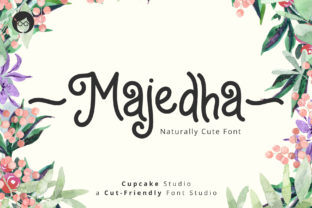
AL Majedha is a premium display font built for impact without sacrificing elegance. Its letterforms carry subtle curves and balanced proportions—a refined script-meets-serif hybrid that feels both timeless and quietly modern. There are no exaggerated flourishes or distracting swashes, just clean confidence in every glyph. It’s the kind of typeface that makes “Hand-Poured Soy Candle” on a kraft label look like a luxury detail—not an afterthought.
I use AL Majedha across physical and digital product lines: candle labels cut on my Cricut Maker, wedding welcome boards printed on matte cardstock, printable planner headers, SVG files for Silhouette users, and even heat-transfer designs for linen tote bags. Why? Because it holds up at small sizes (down to 14pt on product tags) and shines large (300pt+ on farmhouse-style wall signs). Unlike many decorative scripts, AL Majedha avoids thin hairlines or fragile joins—so it cuts cleanly on vinyl and prints crisply on uncoated paper.
For wedding stationery, AL Majedha adds sophistication without formality. Try it for names on save-the-dates (“Alex & Sam • October 2025”), monogrammed napkin prints, or foil-stamped menu cards. Its rhythm reads smoothly at arm’s length—critical for signage guests actually pause to read. In printable collections, I pair it with minimalist sans serifs (like Montserrat or Poppins) for contrast: AL Majedha for titles and headings, the sans for body text and instructions. That pairing keeps digital downloads feeling cohesive and professional—especially when buyers resell your templates as part of their own branding kits.
Small-batch product packaging is where AL Majedha truly earns its place in my font library. On honey jar labels, herbal tea tags, or bath salt pouches, it communicates care and craftsmanship. The uppercase “A” and “M” have gentle terminals—not sharp, not blunt—just right for conveying handmade authenticity. And yes, it works beautifully for seasonal items: think “Spiced Cider • Autumn 2024” on a chalkboard-style market sign or “Joyful Beginnings” on newborn announcement cards.
Readability matters most when scaling down. For sticker sheets or mini gift tags (1.5” x 1.5”), I stick to short phrases—names, dates, single words like “Bloom”, “Gather”, or “Celebrate”. Avoid full sentences under 20pt. When prepping files for cutting machines, I always convert AL Majedha to outlines first—no surprises during weeding. And if you’re designing mockups for Etsy listings, preview how it renders on textured backgrounds: its balanced weight prevents visual sinking against linen or watercolor textures.
AL Majedha comes with standard OpenType features—ligatures for smoother “fi”, “fl”, and “ff” connections, plus alternate characters for subtle variation. While it doesn’t include extended multilingual support, it covers full Latin-1 (including accented characters used in French, Spanish, and German), making it safe for bilingual wedding invites or artisanal product names like “Château Lavender” or “Café Sol.” File formats include OTF and TTF—compatible with Canva, Adobe Creative Cloud, Cricut Design Space, Silhouette Studio, and Affinity apps.
Font pairing is intuitive but intentional. With AL Majedha’s quiet confidence, lean into contrast: pair it with a friendly handwritten font (like Quicksand or Yellowtail) for greeting cards where personality matters, or with a sturdy serif (like Playfair Display or Lora) for high-end packaging. Avoid pairing it with other high-contrast display fonts—that’s visual competition, not harmony. One strong voice per layout is all you need.
Commercial licensing is non-negotiable—and AL Majedha includes full commercial rights. That means you can use it to design physical products (stickers, mugs, apparel), digital printables (planner pages, social media quote graphics), SVG bundles for crafters, client-branded invitations, and even white-label templates sold on Etsy or Gumroad. Just remember: you’re licensing usage, not redistribution of the font file itself. So embed it in PDFs, outline it in SVGs, and convert it before uploading to print-on-demand platforms—no sharing raw .OTF files with customers.
In my own shop, AL Majedha has become the go-to for anything needing instant uplift—without extra design labor. It turns “Thank You” tags into heirloom moments. It makes boutique soap labels feel curated, not generic. And when customers comment “I love your typography,” I know it’s working—not as decoration, but as quiet brand language.
If your work lives at the intersection of beauty and function—where every label must inform *and* enchant, every invitation must welcome *and* resonate—AL Majedha isn’t just another display font. It’s a reliable collaborator in your creative process. One that understands handmade values, respects production realities, and never asks your customers to squint.